
Friday, July 29, 2022

Monday, January 3, 2022
Writing a book is one thing, keeping up with technology is another. I am learning, by trial and error, as time goes by. I finally connected my first blog to my author page. The blog was the only viable way to let family and friends know what was happening when I was in the rainforest for weeks at a time. I hope the following link to my facebook page works.Reading the old blog gives some perspective to what is involved when living in a place far, far away and not knowing the customes or language. It worked out O.K. because the Achuar were accepting and supportive. They fed me and kept me safe. And our joint dream came true. My three approved Achuar books are now published. JoAnne's Facebook author page
Monday, December 6, 2021
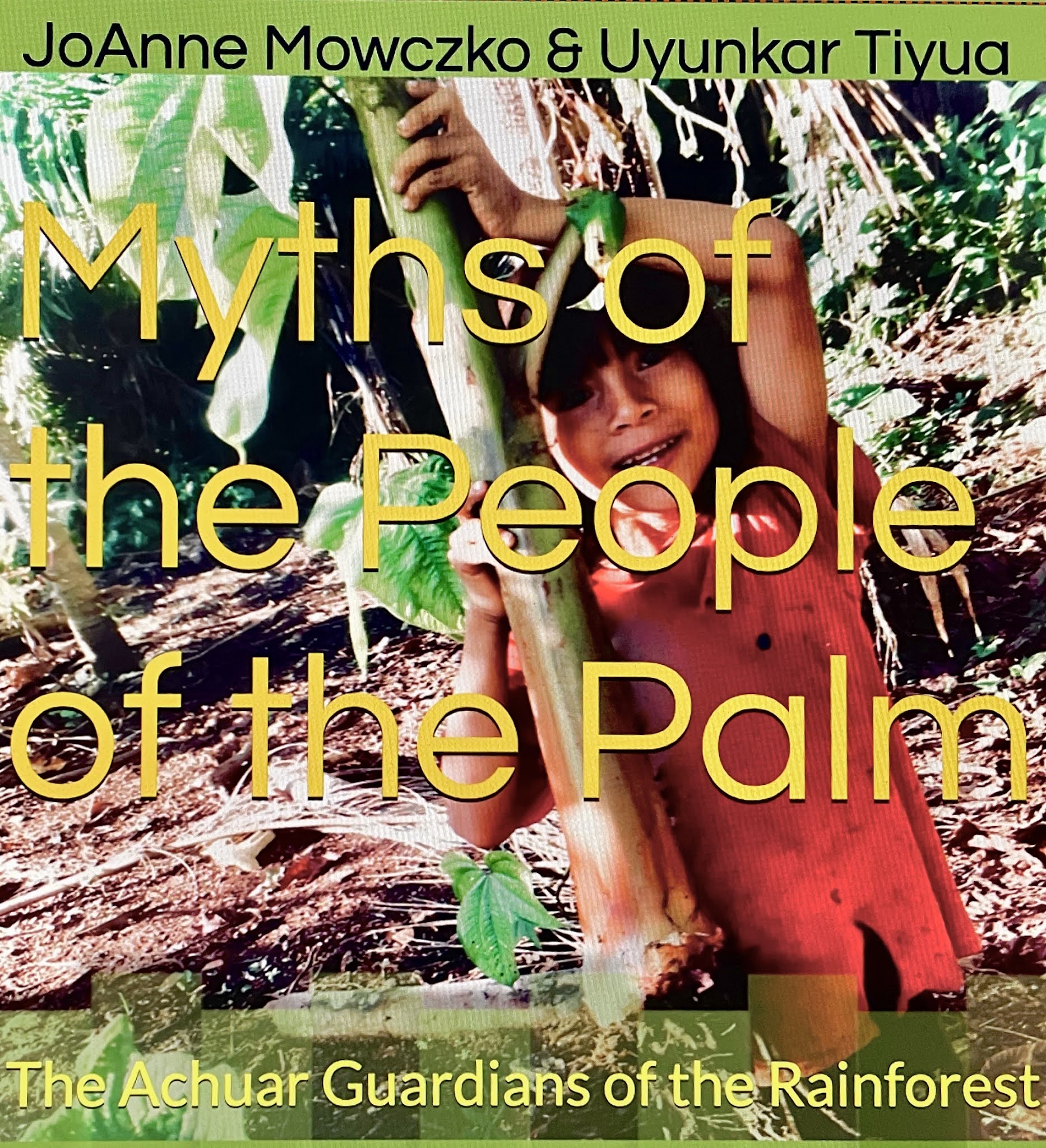
Skip ahead to 2021. I was able to publish The Myths of the People of the Palm this year. The idea for the book emerged when I was visiting the Achuar in 2014 to give them my newly published book, The Achuar of the Pastaza river. While staying at the Kapawi Ecolodge, I joined some of the tourist treks to outlaying villages. On one trek, our naturalist guide, Napoleon Tiyua Uyunkar, and I discussed collaborating on a second book. We agreed to work together, using the internet, to complete the book. This was a wonderful idea, but the reality hit us as we were unable to make progress. Napoleon's limited access to the internet and family obligations caused our work to come to a standstill. The solution was for him to come to me or visa versa. We tried for a visa to the US without success. Instead, in 2017, I traveled over 3,786 miles to reach his village . We worked with Achuar Elders to document eight myths in three languages, with illustrations created by students. When it was time for me to leave, we had a draft. Again we thought we could finish it using the internet. Time passed and we did our best. This year we were able to reach the Achuar dream of a book of myths to share with the world.
The Myths of the People of the Palm Myths of the People of the Palm
The Achuar of the Pastaza River The Achuar of the Pastaza River
Both books are available on Amazon.com
Reading the Achuar of the Pastaza River will enhance the understanding of the Achuar myths.
Tuesday, September 28, 2021
Just released, two new books

Monday, February 13, 2017
All part of getting ready to travel.
I went to the Dentist today, 32nd St. Dental. Cleaning. They donated 40 tooth brushes for the Achuar community of Pukuan. Thank you Dr. Carroll.
I spent a good amount of time removing them from their cardboard and plastic wrapping. I placed them in a big zip lock. I am saving every once of luggage weight I can, and the Achuar really do not need waste packaging brought into their community.
What do you think about all of the excess packaging? I would say it is partly for display convenience but mostly to keep small items from "walking" out of the store.
Don't you just hate that? You buy an item, it is on a card with a plastic bubble protecting it, you buy it and it is put in a bag and you are given a paper receipt. How much of that goes in the trash?
Just saying...
I went to the Dentist today, 32nd St. Dental. Cleaning. They donated 40 tooth brushes for the Achuar community of Pukuan. Thank you Dr. Carroll.
I spent a good amount of time removing them from their cardboard and plastic wrapping. I placed them in a big zip lock. I am saving every once of luggage weight I can, and the Achuar really do not need waste packaging brought into their community.
What do you think about all of the excess packaging? I would say it is partly for display convenience but mostly to keep small items from "walking" out of the store.
Don't you just hate that? You buy an item, it is on a card with a plastic bubble protecting it, you buy it and it is put in a bag and you are given a paper receipt. How much of that goes in the trash?
Just saying...
Sunday, February 12, 2017
Kapawi travel 2017
My latest and last travel to Kapawi was prompted by a request by the Achuar to help them write a book "telling their story". My Achuar friend, Napoleon, and I have tried to collaborate to write a book using e-mail, Facebook and messenger. Not only is the amount of text limited, Napoleon is seldom in an area where there is internet access. He does not have a computer, and uses small Galaxie for typing.This is a very tedious process. This is not an affective way to make progress. I decided I must go to the rainforest and have face to face time. We have set aside a period of time in Wachirpas community to work together. Unfortunately this writing project is not funded. I have self-funded my previous travel to conduct research. Of course, my time writing, editing and publisheing is donated. This time I was astounded by the inflation in travel costs. This is an import project, this will be the Achuar's first book. I decided to start JoAnne's Achuar Project
My latest and last travel to Kapawi was prompted by a request by the Achuar to help them write a book "telling their story". My Achuar friend, Napoleon, and I have tried to collaborate to write a book using e-mail, Facebook and messenger. Not only is the amount of text limited, Napoleon is seldom in an area where there is internet access. He does not have a computer, and uses small Galaxie for typing.This is a very tedious process. This is not an affective way to make progress. I decided I must go to the rainforest and have face to face time. We have set aside a period of time in Wachirpas community to work together. Unfortunately this writing project is not funded. I have self-funded my previous travel to conduct research. Of course, my time writing, editing and publisheing is donated. This time I was astounded by the inflation in travel costs. This is an import project, this will be the Achuar's first book. I decided to start JoAnne's Achuar Project
Going back again...
2014 Post
It is July 19 and I have just finished all of my vaccinations. Some were still good. I did not have to repeat the hepatitis, Yellow fever, mmr, or rabies. But I did have to have typhus and tetanus again. Not too bad.Then there were all of the scripts and OTCs to get. Since there will no medical services in the communities, I am planning for every possibility from diarrhea to fungal infections and headaches to rashes. For malaria protection, I take one Mefloquinine every week beginning a week out and 3 weeks after my stay in the jungle. Last time down I did get a giardia infection and was quite ill for 5 days.
You can imagine that my medical kit takes up considerable landscape in my suitcase. Since the trip requires flying on a small aircraft and then a boat, luggage is limited to 25 pounds in a soft sided duffle. The duffle can be stuffed into the cargo area. Imagine what you can take with that limitation. The suggestion is 2 sets of clothes, socks for each day, walking shoes, sandals, and a tooth brush. this is just for the lodge. They provide toilet paper and shampoo and wellington boots for hiking. I have to plan for a week in a remote community, too. I must take everything that I will need.
It is July 19 and I have just finished all of my vaccinations. Some were still good. I did not have to repeat the hepatitis, Yellow fever, mmr, or rabies. But I did have to have typhus and tetanus again. Not too bad.Then there were all of the scripts and OTCs to get. Since there will no medical services in the communities, I am planning for every possibility from diarrhea to fungal infections and headaches to rashes. For malaria protection, I take one Mefloquinine every week beginning a week out and 3 weeks after my stay in the jungle. Last time down I did get a giardia infection and was quite ill for 5 days.
You can imagine that my medical kit takes up considerable landscape in my suitcase. Since the trip requires flying on a small aircraft and then a boat, luggage is limited to 25 pounds in a soft sided duffle. The duffle can be stuffed into the cargo area. Imagine what you can take with that limitation. The suggestion is 2 sets of clothes, socks for each day, walking shoes, sandals, and a tooth brush. this is just for the lodge. They provide toilet paper and shampoo and wellington boots for hiking. I have to plan for a week in a remote community, too. I must take everything that I will need.
Fe. 2017
My calendar is filled with "vaccine dates".
I am in the midst of planning and packing for a month-long visit to Achuar land in Ecuador. This will be my 4th time there. At my age, this will also be my last. Preparations include getting all of the immunizations recommended for Ecuador. And they have to be spaced over time. In January I received Yellow Fever and Japanese Encephalitis vaccines. Since they contain live virus, I had to wait a month before I could have the next two. Feb 2 was a red letter day: Meningitis and rabies shot # 1. Feb. 9 was rabies #2. Feb. 23 will be my last rabies shot. At least my Hepatitis A and B and T-dap are up to date and I caught a break on the Typhoid vaccine, it is a capsule that I will take on Feb. 16, 18, and 20th. I start my malaria pills 3 days out.
My calendar is filled with "vaccine dates".
I am in the midst of planning and packing for a month-long visit to Achuar land in Ecuador. This will be my 4th time there. At my age, this will also be my last. Preparations include getting all of the immunizations recommended for Ecuador. And they have to be spaced over time. In January I received Yellow Fever and Japanese Encephalitis vaccines. Since they contain live virus, I had to wait a month before I could have the next two. Feb 2 was a red letter day: Meningitis and rabies shot # 1. Feb. 9 was rabies #2. Feb. 23 will be my last rabies shot. At least my Hepatitis A and B and T-dap are up to date and I caught a break on the Typhoid vaccine, it is a capsule that I will take on Feb. 16, 18, and 20th. I start my malaria pills 3 days out.
Wednesday, September 30, 2015
Achuar Oil
I blog I never posted, 2014:
I returned to Kapawi Ecolodge last July. Initially I headquartered at the lodge. The manager, Andrés, arranged meetings there to discuss my book status and conduct additional research. While there I presented copies of my book The Achuar of the Pastaza River to Achuar leaders and a copy of the cover photo to Alfredo Palora. When I was doing research in Kusutkau he allowed me to photograph his family and he is on the book cover. I traveled upstream to Sharamentsa where many tribal leaders gathered for a day long Achuar association meeting focussing on the crisis the Achuar are facing with impending oil development in the Amazon. Note: the oil situation has not improved
I returned to Kapawi Ecolodge last July. Initially I headquartered at the lodge. The manager, Andrés, arranged meetings there to discuss my book status and conduct additional research. While there I presented copies of my book The Achuar of the Pastaza River to Achuar leaders and a copy of the cover photo to Alfredo Palora. When I was doing research in Kusutkau he allowed me to photograph his family and he is on the book cover. I traveled upstream to Sharamentsa where many tribal leaders gathered for a day long Achuar association meeting focussing on the crisis the Achuar are facing with impending oil development in the Amazon. Note: the oil situation has not improved
Amazon Oil
Amazon oil auctionI returned to Kapawi Ecolodge last July. Initially I headquartered at the lodge. The manager, Andrés, arranged meetings to discuss the book status and conduct additional research. While there I presented copies of my book The Achuar of the Pastaza River to Achuar leaders and a copy of the cover photo to Alfredo Palora. When I was doing research in Kusutkau he allowed me to photograph his family and is on the book cover. I traveled upstream to Sharamentsa where many tribal leaders gathered for a day long Achuar association meeting focussing on the crisis the Achuar are facing with impending oil development in the Amazon.
Saturday, July 19, 2014
Return to the rainforest
Return to Kapawi
The rainforest calls to me. Once a person spends some time so close to nature, it attaches itself to you at some level. I feel this longing to stand among the ancient trees. Perhaps it is Arutam, the ancient wisdom residing in the forest.
Post written in 2014
I am returning to Kapawi Ecolodge. This will be my first time back since publishing “The Achuar of the Pastaza River”. I will be doing further research. I have in mind to visit with my acquaintances in Kusutkau, Kapawi and Wachirpas communities. They are lovely people and it will be good to see them again. They were helpful in providing me with the information needed for my book. The same can be said for the staff at Kapawi Ecolodge. I am quite excited to be returning to see my Achuar friends there.
I am returning to Kapawi Ecolodge. This will be my first time back since publishing “The Achuar of the Pastaza River”. I will be doing further research. I have in mind to visit with my acquaintances in Kusutkau, Kapawi and Wachirpas communities. They are lovely people and it will be good to see them again. They were helpful in providing me with the information needed for my book. The same can be said for the staff at Kapawi Ecolodge. I am quite excited to be returning to see my Achuar friends there.
I will be visiting a new community this trip. Remigo invited me to visit his community, Ishpingo, when I was in Kapawi in 2011. He has since moved to a new community, Pukuan, formed with his brothers and nephews. I am honored to be their first outside visitor.
I will also be doing further editing and research. So there are several reasons to return to Kapawi.
As exciting as the prospect of returning to Kapawi is, there is the reality of preparing for the trip. Setting the dates to be in the lodge was the first hurdle. Then the preparations began. First to consider are health precautions. I checked the CDC website for information. Checkhttp://wwwnc.cdc.gov/travel/destinations/traveler/none/ecuador.
In addition to being up to date on routine vaccinations (polio, MMR, DDP, chicken pox, and flu) the health risks in Ecuador indicate the need for the following vaccinations: hepatitis A and B, Typhoid, rabies, and yellow fever. For malaria prevention, I will be taking one mefloqunine for the next 8 weeks. Then there are other health risks to prepare for, too. I have to filter my drinking water, or boil it. I need mosquito netting over my bed while in Remigio’s community. I will be buying the netting in Quito, and am taking a water filter.
I know I will have to keep in mind the mantra “cook it, peel it or don't eat it” while I am visiting the communities. The most challenging is the chicha (manioc beer). Since the preparation process involves saliva, it is on the “should not” list, but it is cultural protocol to drink it when offered (which is often). This does cause a dilemma. To be socially correct, I must accept it. But my physician told me it is not a good idea. When I last visited the communities, my interpreter explained that I was allergic to alcohol. In fact, medications I take are contraindicative for alcohol. But this was not understood, and I was served chicha anyway. At first I just politely held the bowl. But eventually I did partake, even if small sips. The bowl is constantly refilled, so you can never get to the bottom any way. Fortunately, I escaped any illness that might come from drinking the chicha. We will see how it goes this trip.
So, the prep for the trip goes on. I created a medical kit containing any items ordinarily on hand at home. There is no drugstore in the rainforest. Hopefully I will not need most of the items. But I will be prepared! Cuts, burns, bites, fungus, headaches, sore throat…
With the health considerations taken care of, now I will pack my clothes. Since part of the travel to get to the lodge involves a small aircraft and a large canoe, I am restricted to 25 pounds.
More on how this all worked out next time.
Return to Kapawi
The rainforest calls to me. Once a person spends some time so close to nature, it attaches itself to you at some level. I feel this longing to stand among the ancient trees. Perhaps it is Arutam, ancient wisdom residing in the forest.
I am returning to Kapawi Ecolodge. This will be my first time back since publishing “The Achuar of the Pastaza River”. I will be doing further research. I have in mind to visit with my acquaintances in Kusutkau, Kapawi and Wachirpas communities. They are lovely people and it will be good to see them again. They were helpful in providing me with the information needed for my book. The same can be said for the staff at Kapawi Ecolodge.
I am quite excited to be returning to see my Achuar friends there.
I will be visiting a new community this trip. Remigo invited me to visit his community when I was in Kapawi in 2011. He has since moved to a new community, formed with his brothers and nephews. I am honored to be their first outside visitor.
So there are various reasons to return to Kapawi.
As exciting as the prospect of return to Kapawi, there is the reality of preparing for the trip. Setting the dates to be in the lodge was the first hurdle. Then the preparations began. First to consider are health precautions. I checked the CDC website for information. Checkhttp://wwwnc.cdc.gov/travel/destinations/traveler/none/ecuador.
In addition to being up to date on routine vaccinations (polio, MMR, DDP, chicken pox, and flu) the health risks in Ecuador indicate the need for the following vaccinations: hepatitis A and B, Typhoid, rabies, and yellow fever. For malaria prevention, I will be taking one mefloqunine for the next 8 weeks. Then there are other health risks to prepare for, too. I have to filter my drinking water, or boil it. I need mosquito netting over my bed while in Remigio’s community. I will be buying the netting in Quito, and am taking a water filter.
I know I will have to keep in mind the mantra “cook it, peel it or don't eat it” while I am visiting the communities. The most challenging is the chicha (manioc beer). Since the preparation process involves saliva, it is on the “should not” list, but it is cultural protocol to drink it when offered (which is often). This does cause a dilemma. To be socially correct, I must accept it. But my physician told me it is not a good idea. When I last visited the communities, my interpreter explained that I was allergic to alcohol. In fact, medications I take are contraindicative for alcohol. But this was not understood, and I was served chicha anyway. At first I just politely held the bowl. But eventually I did partake, even if small sips. The bowl is constantly refilled, so you can never get to the bottom any way. Fortunately, I escaped illness caused by the chicha. We will see how it goes this trip.
So, the prep for the trip goes on. I created a medical kit containing any items ordinarily on hand at home. There is no drugstore in the rainforest. Hopefully I will not need most of the items. But I will be prepared! Cuts, burns, bites, fungus, headaches, sore throat…
With the health considerations taken care of, now I will pack my clothes. Since part of the travel to get to the lodge involves a small aircraft and a large canoe, I am restricted to 25 pounds.
More on how this all worked out next time.
Tuesday, June 24, 2014
Baby steps
The first step in starting my research began long before I set foot in Ecuador. I researched on the web and read numerous books on the rainforest and indigenous peoples. Information on the Achuar was quite limited at that time. I prepared outlines and questions for my interviews with the Achuar. I also spend many hours in my attempt to learn Spanish. There was also the preparation for the trip itself.
Now that I will be returning to the rainforest, I am remembering what I had to do to prepare for my first research trip. I checked with the health department to find out what immunizations were required and what were recommended. Recommended were Hepatitis A and B, Typhoid, Yellow Fever, Rabies, MMR, and Tetanus. I decided I needed the rabies protection, since I would be staying in the communities. Ten Achuar children died from rabies transmitted by vampire bats in Morona Santiago province in 2011. This is the area where I would be staying. It is not possible to get the needed immunizations in Yuma, AZ. I had to travel to El Centro, CA. I visited my primary provider for scripts for mefloqunine, cipro, an anti-dirrheal, and an anti-fungal cream. I also needed an adequate supply of my regular scripts.
Then came the decisions about what to take. I was allowed 25 pounds. The last legs of the journey to Kapawi ecolodge are in a small aircraft and then a canoe. Less is more when traveling that way. Packing was very challenging. I would be staying in Kapawi for 7 weeks. The lodge provided a list of suggestions for the tourists that visit for a 3 or 5 days stay. Three changes of clothes and knee socks. limited personal items.That was a start. Eco-friendly shampoo/soap would be provided at the lodge. Electricity would be available for recharging cameras. What is important is long sleeves, long pants, and knee-high socks to help prevent insect bites. I would need lots of flashlight batteries, insect repellent and hand sterilizer. One mistake I made was to take my lace-up hiking shoes. After one hike in the rain they never dried out! I packed and repacked many times, continually triaging and eliminating items. Surprising what you can manage without when you have a 25 pound limit! What I will take this time is powdered gator aide and chocolate.
My journey from Yuma to phoenix to Miami to Quito went well. I arrived at the hotel late and had an early morning meeting with the Kapawi staff in the Quito office. We reviewed the logistics and discussed the parameters of the project. Fortunately, their English was better than my Spanish. Since we were meeting for the first time, it was a relief to find such able, helpful, and cordial staff. The following day was sightseeing around Quito and dinner with Sebastian, our Ecuadorian naturalist guide from 2008. We had a wonderful visit and he gave me guidance regarding my stay in the communities.
Next, the bus ride through the Valley of Volcanos to reach Shell, Ecuador
Now that I will be returning to the rainforest, I am remembering what I had to do to prepare for my first research trip. I checked with the health department to find out what immunizations were required and what were recommended. Recommended were Hepatitis A and B, Typhoid, Yellow Fever, Rabies, MMR, and Tetanus. I decided I needed the rabies protection, since I would be staying in the communities. Ten Achuar children died from rabies transmitted by vampire bats in Morona Santiago province in 2011. This is the area where I would be staying. It is not possible to get the needed immunizations in Yuma, AZ. I had to travel to El Centro, CA. I visited my primary provider for scripts for mefloqunine, cipro, an anti-dirrheal, and an anti-fungal cream. I also needed an adequate supply of my regular scripts.
Then came the decisions about what to take. I was allowed 25 pounds. The last legs of the journey to Kapawi ecolodge are in a small aircraft and then a canoe. Less is more when traveling that way. Packing was very challenging. I would be staying in Kapawi for 7 weeks. The lodge provided a list of suggestions for the tourists that visit for a 3 or 5 days stay. Three changes of clothes and knee socks. limited personal items.That was a start. Eco-friendly shampoo/soap would be provided at the lodge. Electricity would be available for recharging cameras. What is important is long sleeves, long pants, and knee-high socks to help prevent insect bites. I would need lots of flashlight batteries, insect repellent and hand sterilizer. One mistake I made was to take my lace-up hiking shoes. After one hike in the rain they never dried out! I packed and repacked many times, continually triaging and eliminating items. Surprising what you can manage without when you have a 25 pound limit! What I will take this time is powdered gator aide and chocolate.
My journey from Yuma to phoenix to Miami to Quito went well. I arrived at the hotel late and had an early morning meeting with the Kapawi staff in the Quito office. We reviewed the logistics and discussed the parameters of the project. Fortunately, their English was better than my Spanish. Since we were meeting for the first time, it was a relief to find such able, helpful, and cordial staff. The following day was sightseeing around Quito and dinner with Sebastian, our Ecuadorian naturalist guide from 2008. We had a wonderful visit and he gave me guidance regarding my stay in the communities.
Next, the bus ride through the Valley of Volcanos to reach Shell, Ecuador
Sunday, June 22, 2014
e-version
"The Achuar of the Pastaza River" is now available in e-version. It is available on Amazon.com. Kindle Edition
Auto-delivered wirelessly
To convert a print book to e version format is time consuming. I thought removing page numbers was all I would have to do. I found out it is much more. There are many format and font issues. Especially when there are photos and captions. I decided to pay for the service. That did not work out as well as it could have. The conversion process took two 2 months. There were many wrinkles in the process.
The importance of an e-version out weighs the frustration and personal time involved in producing it. The book will now be more accessible and portable. Ecotourists, naturalist guides and volunteers going to the Amazon can download the book at any time. It is a great resource. I hope it is enjoyed by many.
To convert a print book to e version format is time consuming. I thought removing page numbers was all I would have to do. I found out it is much more. There are many format and font issues. Especially when there are photos and captions. I decided to pay for the service. That did not work out as well as it could have. The conversion process took two 2 months. There were many wrinkles in the process.
The importance of an e-version out weighs the frustration and personal time involved in producing it. The book will now be more accessible and portable. Ecotourists, naturalist guides and volunteers going to the Amazon can download the book at any time. It is a great resource. I hope it is enjoyed by many.
Writing a manuscript is just a start...
My initial project was to live with the Achuar and write a book about their culture. Kapawi Manager Andrés Ordóñez arranged for me to live at the lodge and visit 6 communities. During my stay I interviewed many people, took photographs and observed the Achuar way of life.
It was a new challenge for me to be in a foreign land, not speak the native language and not be able to go anywhere without a guide. The Achuar are a warm and accepting people. I was welcomed and they tolerated my endless questions.
Little did I know that when I started this project, I would also be the publisher, and then do the conversion to e-format. I have learned much more working on the book "The Achuar of the Pastaza River" than the Achuar culture.
I will go back to Kapawi and do follow-up research and visit my Achuar friends. I miss them and look forward to seeing them again and learning more about them.
And I will have many more questions for them.
It was a new challenge for me to be in a foreign land, not speak the native language and not be able to go anywhere without a guide. The Achuar are a warm and accepting people. I was welcomed and they tolerated my endless questions.
Little did I know that when I started this project, I would also be the publisher, and then do the conversion to e-format. I have learned much more working on the book "The Achuar of the Pastaza River" than the Achuar culture.
I will go back to Kapawi and do follow-up research and visit my Achuar friends. I miss them and look forward to seeing them again and learning more about them.
And I will have many more questions for them.
Wednesday, April 30, 2014
Miami to Quito
I must admit, taking on a project that involved living in a foreign country for 7 weeks and not speaking the native language was daunting. But in retrospect, I did fine with limited Spanish skills and no Achuar language skills.
While waiting in the Miami-Dade International Airport for my flight to Quito, I met someone who was from Quito and worked as a cook in Coca, an oil village near Quito. Ironic that I would meet someone who worked for a German oil company while I was concerned about the oil development on Achuar territory. She had been visiting her daughter in the States and was now headed home. She spoke English quite well and spent the hours talking about her family and my plans while in Ecuador. She invited me to stay with her in Quito. Such a lovely lady.
Arriving in Quito sent us on our separate ways. I had a reservation at a hotel, and the next morning a 7 a.m. meeting with Pedro A. Pedro and I had been e-mailing and skyping for a year or so to work out all of the details regarding writing a book about the Achuar. He was my contact person at the Kapawi Ecolodge Quito office.
While waiting in the Miami-Dade International Airport for my flight to Quito, I met someone who was from Quito and worked as a cook in Coca, an oil village near Quito. Ironic that I would meet someone who worked for a German oil company while I was concerned about the oil development on Achuar territory. She had been visiting her daughter in the States and was now headed home. She spoke English quite well and spent the hours talking about her family and my plans while in Ecuador. She invited me to stay with her in Quito. Such a lovely lady.
Arriving in Quito sent us on our separate ways. I had a reservation at a hotel, and the next morning a 7 a.m. meeting with Pedro A. Pedro and I had been e-mailing and skyping for a year or so to work out all of the details regarding writing a book about the Achuar. He was my contact person at the Kapawi Ecolodge Quito office.
Friday, April 4, 2014
More Preparation
I do not speak Spanish. I have taken classes throughout my
life, but it doesn’t take. I tried Rosetta Stone, and then a quick intensive study
with a friend who is a linguist. All to no avail. So I head out, trusting that my
rudimentary Spanish skills will get me through. I will have interpreters
sometimes, but I have to get to Kapawi first. I will be traveling in Ecuador.
Their language is Spanish.
Preparation
The proposal was accepted! Now, to prepare for 7 weeks in the rainforest.
There were immunizations to get, a supply of preventative meds., quick-dry
clothes to round up, knee socks, personal items, flashlight, batteries, binocs,
camera, laptop… the list was long, the space in one duffle small. The weight
limits were challenging. The small planes that fly from Shell to an Achuar
community transport tourists to the lodge as well as supplies. Everything has
to be flown in. That means each person is limited to 25 pounds. That was a big
challenge. I tried to think of every contingency.
Sunday, March 30, 2014
Persistence
After I made the decision to write a book about the Achuar culture, I had
to find a way to do field work in Kapawi. This process lasted over two years.
I wrote many inquiries, to many places. Finally, when I thought it was
not going to work, I received communication from the Kapawi Ecolodge
headquarters in Quito. Viviana had received my request and left it for her
predecessor, Pedro. I have never met Viviana, but she is the one that set
everything in motion. Andrés, manager of the Ecolodge, assigned Pedro to work
on the possibilities of a book. I was asked to submit a proposal. Finally,
after so long, I would have an opportunity to explain my vision.
Birth of an idea
New Book:
The Achuar of the Pastaza River
A Glimpse into Their Lives
The birth of an idea:
What started out as a short excursion in the Amazon rainforest turned into a three year project. My husband and I spent three days at Kapawi Ecolodge in 2008. We enjoyed the hiking and bird watching excursions, but had minimal contact with the Achuar culture.
After returning to our desert home in AZ I just could not get the Achuar out of my mind. I wanted to know more, and further, I wanted the information about their rich culture to be available to the naturalist guides and the tourists who visit the ecolodge from around the world.
That was the beginning of a two year endeavor to make contact with someone in Kapawi who shared my vision and could help make it happen.
The book is now available on Amazon.com, and CreateSpace
Subscribe to:
Posts (Atom)